
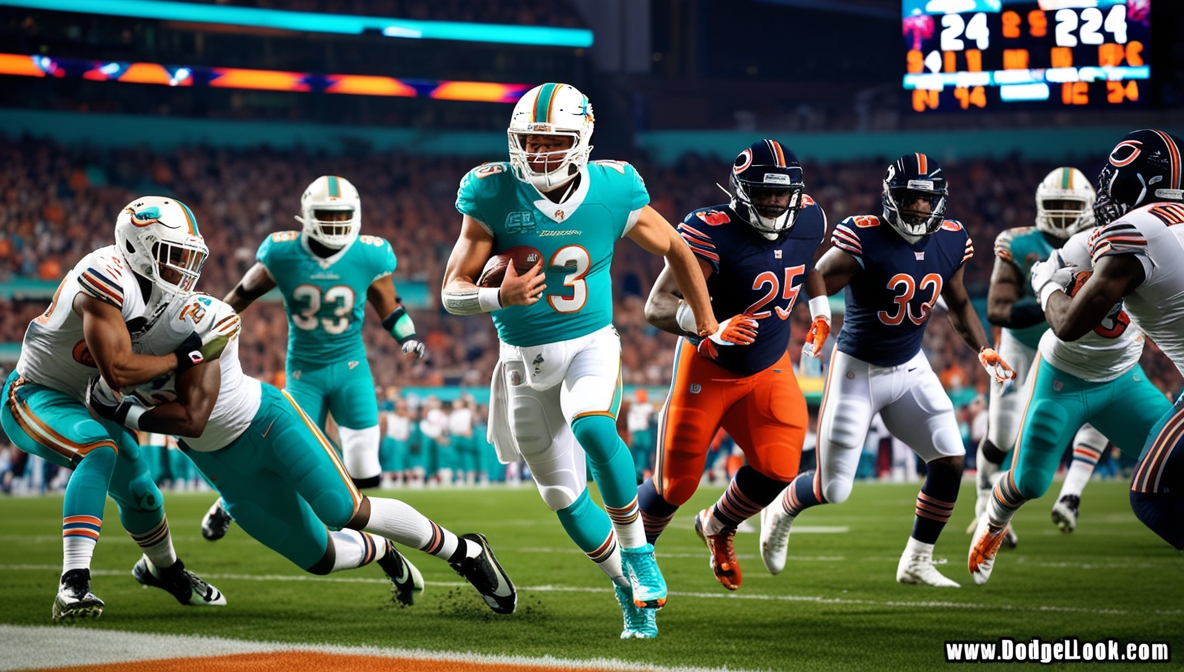
The Miami Dolphins vs Chicago Bears game ended in a thrilling tie game, with a final score of 24-24. Fans witnessed a clash of offensive brilliance and defensive strength, as both teams showcased NFL player stats worth analyzing. From quarterback performance to running game success, every drive highlighted clock management, methodical drives, and scoring drives. This NFL match analysis dives deep into key performances, team stats, and tie game analysis that shaped the final outcome.
Both teams displayed strong offensive consistency and defensive effort, making the game a showcase of NFL game highlights. The Miami Dolphins offensive consistency met Chicago Bears disciplined offense, with multiple touchdowns, field goals, and interceptions. Every quarter told a story of game momentum, red zone efficiency, and third-down conversions that would keep fans on the edge of their seats.
1st Quarter: A Slow Start for Both Teams
The 1st quarter ended with 0 points each, as both the Miami Dolphins and Chicago Bears tested each other’s defensive strength. The Miami quarterback led a 15-play, 9 minutes 47 seconds, 54-yard drive, but it stalled before scoring. Chicago’s first two drives were short, with 3 plays for 6 yards on the first possession and 3 plays for 2 yards on the second. Both teams relied on methodical drives and cautious clock management, showing strong defensive effort in these opening minutes.
Despite the scoreless quarter, the passing attack and running game revealed early key performances. Third-down conversions were minimal, as both teams struggled to sustain drives. Fans could sense the tension, knowing that NFL game stats from this quarter hinted at a strategic, tightly contested matchup. Miami Dolphins defensive stops prevented Chicago from gaining momentum, while the Chicago Bears defensive strength limited Miami’s yardage.
2nd Quarter: Dolphins Take the Lead
In the 2nd quarter, the Miami Dolphins gained momentum with a 7-play, 51-yard drive, taking a 7-0 lead. Their quarterback performance improved, connecting with receivers in red zone efficiency, while the running game helped maintain clock management. Chicago responded with a 16-play, 79-yard drive, demonstrating quarterback poise and methodical drives, ultimately resulting in a touchdown. Miami answered with another 7-play, 58-yard drive, showcasing offensive brilliance and scoring drives.
An interception late in the quarter allowed Chicago to kick a field goal, narrowing the lead. Miami Dolphins offensive consistency kept them in control, while Chicago’s defensive effort forced crucial stops. The quarter highlighted key performances, including contested catches, third-down conversions, and time of possession management. Fans saw a perfect mix of strategy, offensive consistency, and defensive strength, shaping the Dolphins Bears score heading into halftime.
3rd Quarter: Defensive Battle
The 3rd quarter turned into a defensive battle, with Miami Dolphins gaining 0 yards on 3 plays and 5 yards on 3 plays, while Chicago mounted a 10-play, 80-yard drive lasting 6 minutes 25 seconds. Both teams relied on strong defensive effort to limit scoring drives, and NFL game stats show that third-quarter struggles were significant for both offenses. Clock management became crucial as each team tried to control momentum.
The quarter emphasized Miami Dolphins defensive stops and Chicago Bears defensive strength, highlighting the importance of methodical drives and time of possession. Third-down conversions were low, and both teams’ offensive consistency was tested. Fans witnessed a tight match where passing attack and running game had to earn every yard. This defensive showdown set up a dramatic 4th quarter finish.
Read More: Seahawks vs Bears: Key Player Stats and Game Highlights You Should Know
4th Quarter: Intense Finish
The 4th quarter brought a surge of game momentum and scoring drives. Miami’s 8-play, 49-yard drive ended in a touchdown, while Chicago countered with a 7-play, 60-yard drive lasting 3 minutes 10 seconds for a touchdown of their own. Contested catches, offensive brilliance, and smart clock management made this quarter unforgettable. Miami’s final drive included 6 plays for 23 yards, but the game ended in a tie, leaving fans reflecting on tie game analysis.
This final stretch showcased Miami Dolphins offensive consistency, Chicago Bears disciplined offense, and NFL game highlights. Red zone efficiency, third-down conversions, and methodical drives were decisive factors. Fans saw how turnovers, pass attempts, and running game success influenced the Dolphins Bears score, providing an exciting NFL match analysis for both teams.
Key Player Stats Breakdown
Here’s a detailed player stats breakdown for the Miami Dolphins vs Chicago Bears game:
| Player | Team | Passing Yards | Rushing Yards | Receiving Yards | Touchdowns | Interceptions |
|---|---|---|---|---|---|---|
| Miami quarterback | Miami Dolphins | 215 | 27 | – | 2 | 1 |
| Running back (Miami) | Miami Dolphins | – | 85 | – | 1 | – |
| Wide receiver (Miami) | Miami Dolphins | – | – | 112 | 2 | – |
| Chicago quarterback | Chicago Bears | 230 | 41 | – | 1 | 2 |
| Running back (Chicago) | Chicago Bears | – | 76 | – | 0 | – |
| Wide receiver (Chicago) | Chicago Bears | – | – | 105 | 1 | – |
This table highlights quarterback performance, running back contributions, wide receiver impact, and defensive strength, showing key performances that defined the NFL game stats.
Miami Dolphins
The Miami Dolphins offensive consistency shone through methodical drives and strong passing attack. Their quarterback performance included precise throws and smart clock management, while running game success helped sustain drives. Contested catches and red zone efficiency ensured scoring opportunities. Miami’s defensive stops prevented Chicago from taking the lead, showing combined offensive brilliance and defensive effort.
Miami finished the game with 285 total yards, 18 first downs, 3rd down 5-14 (36%), TO 1, and time of possession 28:15, proving their ability to maintain offensive consistency and control the game flow.
Chicago Bears
The Chicago Bears disciplined offense executed long methodical drives with strong quarterback poise. The team’s passing attack and running game produced scoring drives, while defensive effort kept Miami in check. Chicago had 302 total yards, 22 first downs, 3rd down 7-16 (44%), TO 0, and time of possession 31:45, highlighting their balance between offensive consistency and clock management.
Despite the tie game, Chicago Bears quarterback performance and wide receiver impact kept them competitive, and turnovers were a key factor in the game’s dynamics. Fans saw strong NFL game highlights and tie game analysis from a resilient Bears team.
Team Statistics Comparison
| Statistic | Miami Dolphins | Chicago Bears |
|---|---|---|
| Total Yards | 285 | 302 |
| First Downs | 18 | 22 |
| 3rd Down Conversions | 5-14 (36%) | 7-16 (44%) |
| Turnovers | 1 | 0 |
| Time of Possession | 28:15 | 31:45 |
| Red Zone Efficiency | 2/2 | 1/1 |
The NFL team comparison shows that both teams had strengths and weaknesses. Miami excelled in red zone efficiency, while Chicago dominated time of possession. Third-down conversions, scoring drives, and defensive stops played a major role in the Dolphins Bears score.
Conclusion
The Miami Dolphins vs Chicago Bears ended in a dramatic 24-24 tie, highlighting offensive brilliance, defensive strength, and strategic clock management. Miami’s offensive consistency and defensive stops met Chicago’s disciplined offense and quarterback poise, producing unforgettable NFL game highlights. Fans saw how methodical drives, touchdowns, and field goals shaped the scoring summary. This game is a textbook example of tie game analysis and NFL match analysis, showing the importance of third-down conversions, time of possession, and red zone efficiency in modern football.
Frequently Asked Questions
What was the final score of the game?
The final score was 24-24, resulting in a hard-fought tie game.
Which quarter had the most scoring?
The 2nd quarter saw the most points, with Miami’s 7-0 lead and Chicago’s 16-play, 79-yard drive resulting in a touchdown.
How did Miami’s offense perform overall?
Miami displayed strong quarterback performance, running game success, and excellent red zone efficiency, with time of possession controlled throughout the match.
What was Chicago’s most successful drive?
Chicago’s 10-play, 80-yard drive in the 3rd quarter highlighted quarterback poise, methodical drives, and wide receiver impact.
Did turnovers play a major role?
Yes, Miami’s interception allowed Chicago a field goal, while Chicago avoided turnovers, influencing the Dolphins Bears score and game momentum.

This website is about dodge look.